


A molded case circuit breaker (MCCB) works like an automatic switch. It protects electrical circuits from getting too much power, short circuits, and other problems. People use MCCBs in places that need strong protection, like factories and big buildings. You can reset this device after it turns off, so power comes back quickly and things do not get damaged. The MCCB market is getting bigger around the world. In Asia-Pacific, more factories mean more need for strong circuit protection. The table below shows how different areas use MCCBs:
| Region | Market Share (%) | Key Insights on MCCB Usage and Market Positioning |
| Asia-Pacific | 40-45% | Fast industrial growth; MCCBs used in high-current places. |
| North America | 25-30% | Strong rules; MCCBs used a lot in industry. |
| Europe | 20-25% | High safety standards; MCCBs help smart grids. |
| Other Regions | 5-10% | More people use MCCBs as new buildings are made. |
What is MCCB? It is an important device that keeps electrical systems safe and working well in places with lots of power.
Key Takeaways
- MCCBs keep electrical circuits safe from too much current and short circuits. They help protect people and machines from harm. They use heat and magnets to stop bad currents fast. You can reset them after they trip. MCCBs come in many types and sizes for different jobs. They work in small buildings and big factories. Picking the right MCCB and putting it in right stops fires and damage. It also helps stop power from going out. Checking and taking care of MCCBs often keeps them working well. This makes sure they protect for a long time.
What is MCCB?
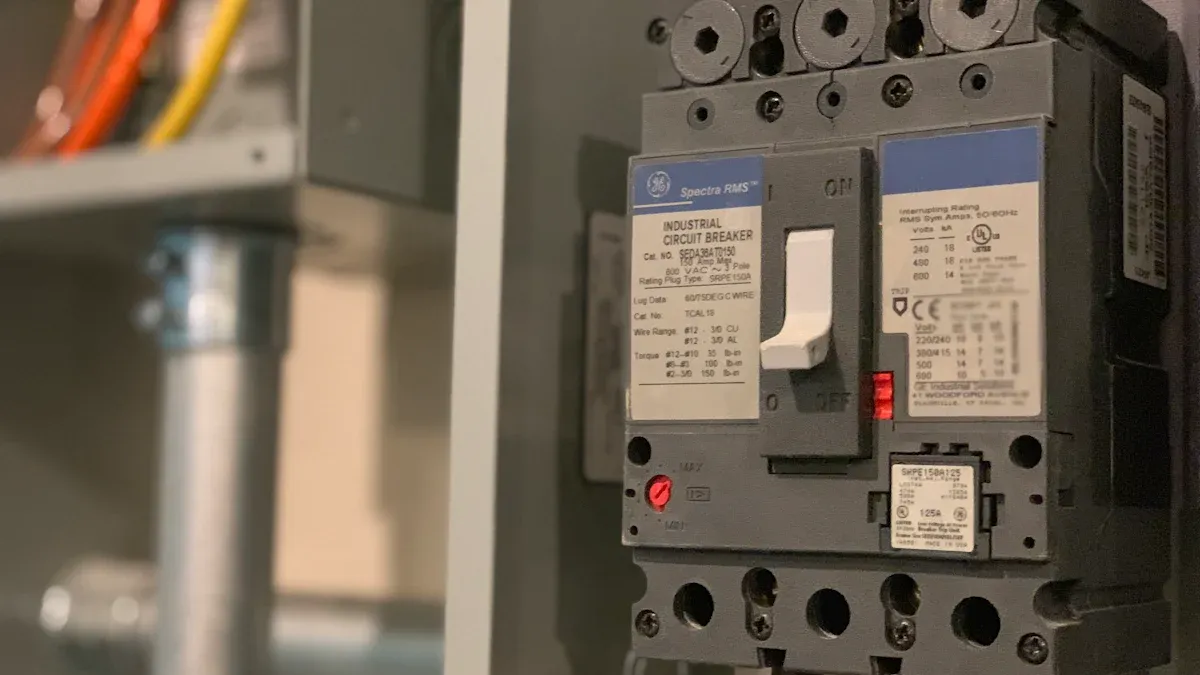
Definition
What is MCCB? Many people ask this when they want to keep electrical systems safe. An MCCB is a device that protects circuits from getting damaged. The UL 489 standard says an MCCB is made as one piece inside a tough, insulated case. This case keeps the inside parts safe and helps the MCCB work well, even in hard places. The case uses special materials that stop electricity from escaping. This makes the MCCB safe and dependable.
International rules also help explain what is MCCB. The IEC 60947-2 standard tells how MCCBs should work in factories. This rule covers devices that can handle up to 1000 V AC and 1500 V DC. It also makes sure MCCBs can work with big currents and in rough places, like factories with dust or heat. Products that follow this rule, like the CHINT NM8N-HV MCCB, show they can work safely in tough spots.
Note: MCCBs must follow strict rules to keep people and equipment safe from electrical dangers.
Main Purpose
What is MCCB? The main job of this device is to keep electrical systems safe and working. MCCBs do this by doing several important things:
- Protection against overloading: The MCCB will open the circuit if the current stays too high. This stops wires from getting too hot and keeps fires from starting.
- Protection against short circuits: If something causes a sudden jump in electricity, the MCCB acts fast and shuts off the power. This keeps both people and equipment safe.
- Manual switching: People can use the MCCB to turn circuits on or off. This helps when fixing things or during emergencies.
- Fire prevention: By stopping dangerous surges and faults, the MCCB lowers the chance of fires or explosions.
- Equipment protection: The MCCB cuts off power during problems, so machines do not get damaged.
What is MCCB? It is a very important part of any electrical system that needs strong and steady protection. Electricians and engineers trust MCCBs to keep power safe, especially where there is a lot of electricity.
How It Works
Overload Protection
MCCBs stop circuits from getting too much power by using a thermal part. This part has a bimetallic strip made from two metals. When a lot of current goes through, the strip gets hot and bends. The bending moves a trip part that opens the circuit. This stops electricity and keeps wires from getting too hot. The MCCB does not open right away for small overloads. It waits a bit so normal use is not stopped. The main parts that help with this are:
- Frame: covers and protects the inside parts.
- Operating mechanism: lets you open or close the breaker.
- Trip unit: finds overloads and short circuits.
- Contacts: join or break the circuit.
- Arc extinguisher: puts out electric arcs when contacts open.
Note: The thermal system in an MCCB helps stop fires and damage by blocking dangerous currents.
Short-Circuit Protection
Short circuits make a big jump in electricity. MCCBs use a magnetic trip part to react fast. This part uses an electromagnet to pull the contacts apart and break the circuit. How fast it works depends on the MCCB type and how big the current spike is.
| MCCB Type | Instantaneous Trip Current Multiple | Typical Tripping Time Range (seconds) |
| Type B | 3 to 5 times rated current | 0.04 to 13 |
| Type C | 5 to 10 times rated current | 0.04 to 5 |
| Type D | 10 to 20 times rated current | 0.04 to 3 |
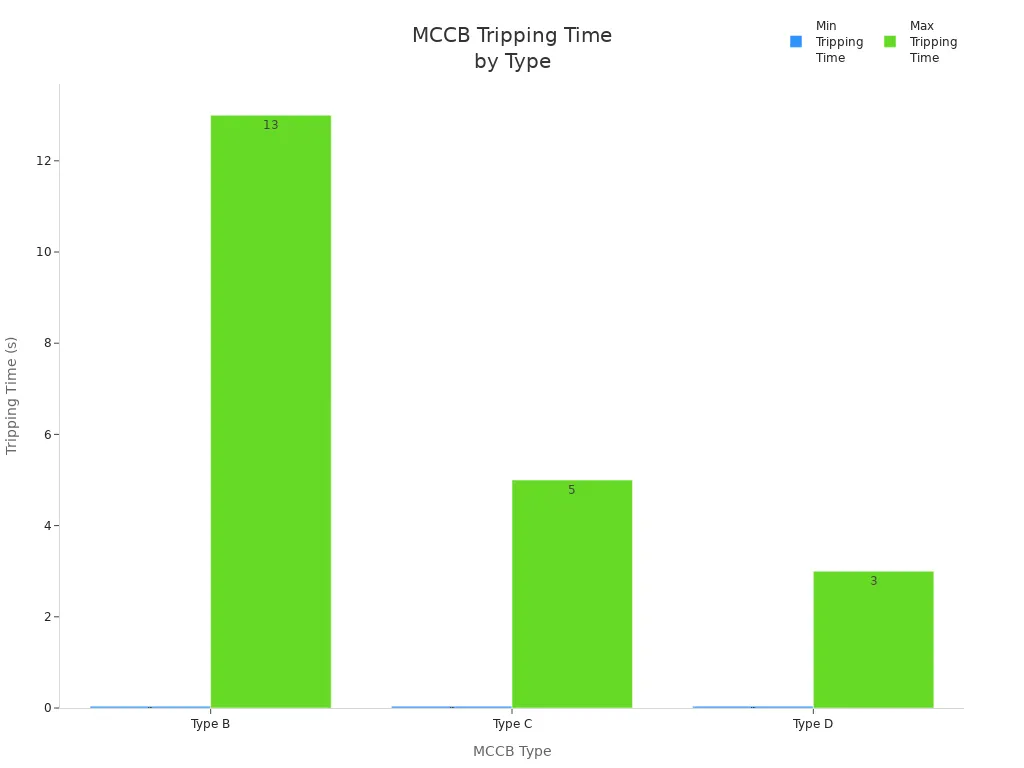
MCCBs use both thermal and magnetic parts. This makes sure they protect against overloads and short circuits quickly and well.
Manual Switching
Manual switching lets people control the MCCB. Workers use this to turn off the circuit before fixing things. The steps are usually:
- Turn off the power and lock the circuit.
- Move the MCCB to OFF to keep the circuit safe.
- Make sure the MCCB works and the trip part is okay.
- Check the circuit stays off while fixing.
These steps help keep people safe and protect equipment during repairs. Manual switching also lets you turn off power fast in emergencies, so MCCBs are important for safety.
Features
Current Range
MCCBs can handle many different amounts of current. This means they can protect small and big electrical systems. Most MCCBs work with currents from 20A to 800A. Some special MCCBs can handle even more current. The table below shows the usual current ranges and where they are used:
| Current Rating Range (Amperes) | Notes |
| 0A – 20A | Low current applications |
| 21A – 75A | Small to medium loads |
| 76A – 250A | Largest market share segment; common in residential and commercial sectors |
| 251A – 800A | Industrial and higher power applications |
| Above 800A | Very high current applications, specialized uses |

The molded case keeps the inside parts safe from dust and water. It also stops people from touching the parts by accident. This makes MCCBs work well even in tough places.
Adjustable Tripping
MCCBs let you change the trip settings for different needs. You can set when the MCCB will turn off for too much current or a short circuit. This helps stop the MCCB from turning off when it does not need to. It also keeps machines and wires safe. The table below shows how these settings help:
| Adjustable Tripping Setting | Description | How it Enhances Protection for Different Loads |
| Continuous Amps (Ir) | Sets the current level the breaker can carry without tripping (20-100% of nominal rating) | Matches trip current to load needs, preventing unwanted trips |
| Long-Time Delay | Delay time (2.2 to 27 seconds at 6x Ir) | Allows for motor starts and temporary surges |
| Short-Time Pickup | Adjustable from 1.5 to 10 times Ir | Ensures only the faulted section trips |
| Short-Time Delay | Delay time (0.05 to 0.5 seconds) | Improves coordination and avoids unnecessary trips |
| Instantaneous Pickup | Trips immediately at 2 to 40 times Ir | Clears severe faults quickly |
| Ground Fault Pickup | Sets ground fault current level (20-70% of max rating) | Customizes ground fault protection for safety |
Thermal trip units use a strip made of two metals. This strip bends when it gets hot and trips the breaker after a short wait. Magnetic trip units work right away if there is a short circuit. Both types make sure the MCCB protects against slow and fast problems.
Resettable Device
You can reset an MCCB after it trips. When there is a problem, the MCCB turns off and opens the circuit. A worker can check the system and then turn the MCCB off and on to reset it. This brings back power fast and keeps things running. Fuses must be replaced after a problem, but MCCBs do not. This saves time and money.
The reset feature, strong trip units, and tough case help MCCBs keep power on. Many MCCBs have locks and lights to show if they are on or off. This makes them safer and easier to take care of.
The design uses both thermal and magnetic parts. This makes MCCBs strong and reliable in many places.
Types & Applications

Types of MCCB
There are different types of MCCBs. Each type works in its own way. The table below lists the main types, their features, and where they are used:
| MCCB Type | Trip Mechanism / Technology | Key Features / Applications |
| Standard MCCB | Thermal-magnetic | Adjustable trip settings; protects against overloads and short circuits; common in residential, commercial, industrial use. |
| Electronic MCCB | Microprocessor-based electronic | Precise trip settings; ground fault protection; phase failure detection; communication capabilities; ideal for sensitive equipment. |
| Hydraulic Electromagnetic MCCB | Hydraulic mechanism with time delay | Reliable for high inrush currents; time-delay feature to withstand temporary overloads; suited for motor and transformer applications. |
| Dual-function MCCB | Thermal-magnetic + electronic | Combines traditional and advanced features; offers ground fault protection; versatile for applications needing both standard and enhanced protection. |
| Special MCCB | Customized features | Designed for specific environments (e.g., weatherproof, high voltage); tailored for industries like oil & gas, mining, renewable energy. |
Standard MCCBs use thermal-magnetic trip units. These are good for most buildings and factories. Electronic MCCBs use microprocessors for better protection. They can find ground faults and phase failures. Hydraulic electromagnetic MCCBs work well with motors and transformers. They handle high inrush currents. Dual-function MCCBs have both old and new features. Special MCCBs are made for special places, like outdoors or high-voltage areas.
Tip: Picking the right MCCB type keeps people and equipment safe.
Where Used
MCCBs are used in many places. They give strong and steady protection. People pick MCCBs because they can handle big currents and tough jobs. Here are some common uses:
- Industrial machines and large transformers
- Motors and motor control panels
- Big HVAC systems in factories
- Commercial buildings with lots of power needs
- Data centers and manufacturing plants
MCCBs have trip settings you can change. This helps match the protection to each system. MCCBs stop overloads and short circuits fast. This lowers the chance of fire or damage. Their design makes them easy to fix, so workers can repair them quickly.
| Aspect | MCCBs (Molded Case Circuit Breakers) | Reason for Preference |
| Common Industries/Environments | Industrial machinery, large transformers, motors and motor control panels, industrial-sized HVAC systems, commercial buildings with large electrical demands | Used in high-power, heavy load environments requiring robust protection |
| Current Ratings | Typically 100A to 2500A | Higher current capacity than MCBs, suitable for larger circuits |
| Trip Settings | Adjustable overload and short circuit trip settings | Allows precise control and customization for specific protection needs |
| Breaking Capacity | Up to 65kA | Can interrupt higher fault currents, essential for industrial safety |
| Durability and Maintenance | Durable and easy to maintain | Suitable for harsh industrial environments and long-term use |
| Application Suitability | Industrial and commercial installations with heavy electrical loads | Provides better control and protection, preventing costly damage to equipment |
MCCBs cost more at first. But they last a long time and are easy to take care of. Many industries use MCCBs to keep their power systems safe and working well.
MCCB vs MCB
Key Differences
MCCBs and MCBs both keep circuits safe. But they are different in many ways. The table below shows how they are not the same:
| Feature | MCCB | MCB |
| Construction | Molded case protects internal parts, helps with heat dissipation | Compact design, fewer safety features |
| Current Rating | Wide range (100A to 2500A or more), for industrial use | Lower ratings (up to 125A), for homes and offices |
| Trip Settings | Adjustable, thermal-magnetic trip units | Fixed trip settings |
| Applications | Industrial plants, motor protection, large power systems | Residential, small commercial, lighting |
| Breaking Capacity | High, can handle large fault currents | Lower, for smaller faults |
| Size and Cost | Larger, more expensive | Smaller, cost-effective |
| Reusability | Resettable, handles varying loads | Resettable, simpler trips |
MCCBs have a strong case that keeps parts safe and cool. They work with bigger currents and let you change trip settings. MCBs are smaller and have fixed settings. People use MCBs in homes and small shops because they are cheaper and fit in small spaces.
Tip: MCCBs give more protection and can be changed for big jobs. MCBs are good for simple, low-power needs.
When to Use Each
You pick an MCCB or MCB based on what you need. MCCBs are best for places with lots of power, like factories or big buildings. They protect against big problems and let you change settings for different machines. MCBs are better for homes, offices, and small stores. They work with lower currents and protect lights, outlets, and small things.
| Criteria for Selection | Use MCCB When | Use MCB When |
| Current Rating | Load current exceeds 100A | Load current below 100A |
| Short Circuit Capacity | Fault currents above 10kA | Fault currents below 10kA |
| Protection Features | Adjustable or custom protection needed | Simple fixed protection is enough |
| Application Type | Industrial, commercial, large systems | Residential, light commercial |
| Maintenance & Lifespan | Long-term use, regular maintenance possible | Shorter cycles, limited maintenance |
| Space & Cost | Space and budget allow for larger devices | Space is tight, cost is a concern |
- MCCBs protect big machines, motors, and large power systems.
- MCBs protect lights, outlets, and small things in homes or offices.
- MCCBs are good when you need to change protection or handle big faults.
- MCBs are best for simple, everyday safety.
Note: Always pick the right breaker for your system to keep power safe and working.
Practical Tips
Sizing
Picking the right MCCB size keeps people and equipment safe. You need to think about a few important things to get the right fit:
- The current rating should be the same or a bit more than the load. Add 25–30% extra for safety and future needs.
- The voltage rating must match the system voltage. This stops problems from happening.
- The interrupting capacity (AIC) should be higher than the biggest fault current.
- The trip type (B, C, D, K, Z) must fit the load and fault type. This helps stop the MCCB from tripping when it should not.
- The number of poles and the shape must fit the circuit and how you install it.
- The place where you use the MCCB matters. Heat and wetness can change how it works.
- Make sure the MCCB works with other protection devices. This way, only the broken part shuts down.
- Think about adding more later. This saves money and trouble in the future.
If you use an MCCB with the wrong rating, it may trip too much, break equipment, or make things unsafe.
Installation
Good installation helps the MCCB work safely and last longer. Only trained electricians should install MCCBs. They do these steps:
- Turn off the power. Wear gloves and safety glasses.
- Get tools like screwdrivers, wire strippers, and voltage testers.
- Look at the MCCB for damage. Make sure it is right for the system.
- Put the MCCB in place. Leave space for air to move.
- Connect the wires to the right spots. Make them tight enough.
- Check all the wires and test the MCCB before turning on power.
Some mistakes are making wire connections outside boxes, cutting wires too short, or using the wrong wire size. These mistakes can make things too hot, cause loose wires, or even start fires. Always follow the maker’s rules and local laws.
Maintenance
Doing regular checks helps the MCCB last longer and keeps things safe. Here are some good habits:
- Look for cracks, color changes, or signs of too much heat.
- Tighten the screws to the right tightness.
- Clean off dust and dirt from the MCCB and panel.
- Test if the MCCB trips and works by hand.
- Use a thermal camera to find hot spots in big buildings.
“Never reset a tripped MCCB without checking for problems first,” as safety rules say. Only trained people should check and fix MCCBs. If the MCCB is broken or fails a test, replace it to keep things safe.
What is MCCB? This device keeps electrical systems safe from too much power and short circuits. Picking the right MCCB and taking care of it helps stop many problems. It also makes the device last longer.
- Checking MCCBs often and putting them in the right way keeps people and machines safe.
- Newer MCCBs with smart features help follow safety rules in many places.
| Marking/Certification | Purpose |
| Rated current | Tells you the safe current limit |
| IEC/EN 60947-2 | Shows the device meets safety rules |
Using MCCBs the right way makes power systems safer and more dependable.
FAQ
What does MCCB stand for?
MCCB stands for Molded Case Circuit Breaker. This device protects electrical circuits from overloads and short circuits. Electricians use MCCBs in places that need strong and reliable circuit protection.
How does an MCCB differ from a fuse?
An MCCB can be reset after it trips. A fuse must be replaced after it blows. MCCBs offer adjustable protection and last longer in most electrical systems.
Can someone use an MCCB in a home?
Most homes use MCBs, not MCCBs. MCCBs work best in places with high power needs, such as factories or large buildings. Some large homes may use MCCBs for special equipment.
How often should someone check an MCCB?
Electricians should check MCCBs at least once a year. Regular checks help find damage, loose wires, or dirt. This keeps the system safe and working well.
What happens if an MCCB trips?
When an MCCB trips, it cuts off power to the circuit. The user should find and fix the problem before resetting the MCCB. This prevents damage and keeps people safe.
Tip: Always let a trained electrician handle MCCB checks and resets for safety.


