


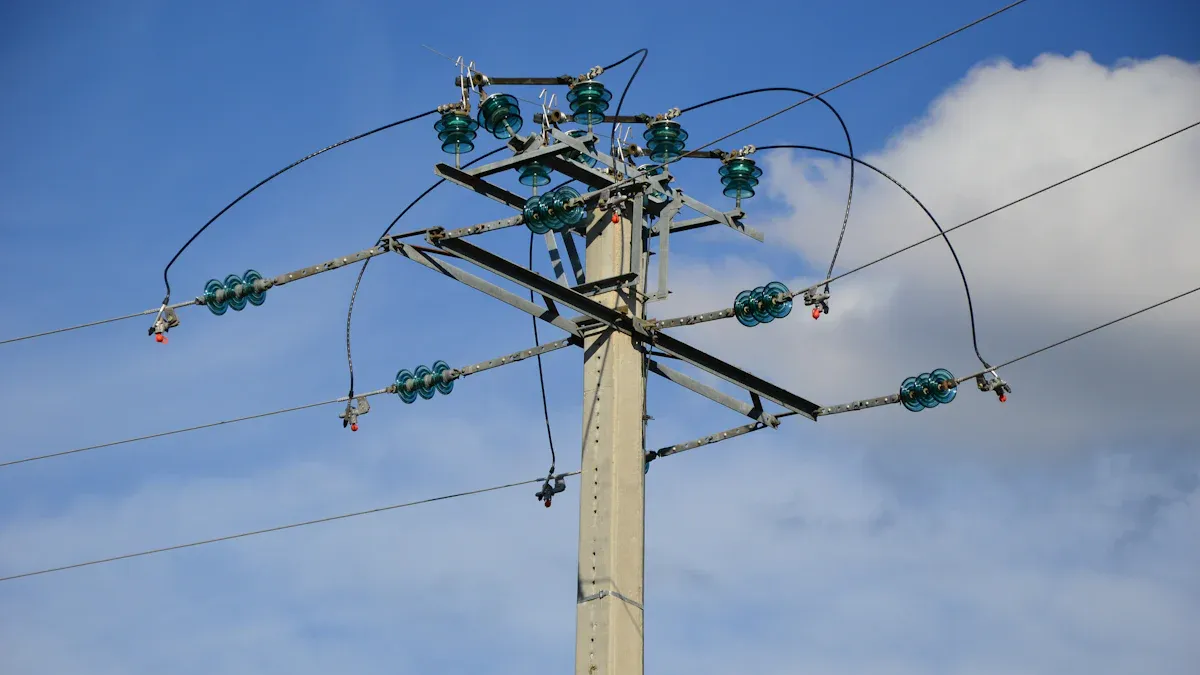
Insulators in transmission lines keep electricity from leaking out. They help keep the lines safe. Insulators stop current from escaping. This prevents arcing and short circuits. Many power companies use insulators because they work well. Toughened glass insulators fail only about once in ten million times over fifty years. Without these barriers, people could get hurt. There could also be power interruptions. Utilities use insulators to hold wires up. They also keep wires apart. This makes sure electricity travels safely and reliably.
Key Takeaways
- Insulators hold electricity inside transmission lines. They stop leaks that can cause power loss, fires, or shocks.
- There are different types of insulators. Suspension, strain, porcelain, glass, and polymer insulators have special jobs. They work well in different weather.
- Cleaning and taking care of insulators often helps stop failures. This keeps power systems safe and working well.
- Using insulators makes the system more reliable. It helps stop outages and makes equipment last longer.
- Picking the right insulator material and design is important. It helps power lines work well and stay safe in bad weather.
Why Use Insulators
Preventing Current Leakage
Transmission lines move strong electricity over long distances. Insulators work like walls that keep electricity inside the wires. Power companies use insulators to stop current from leaking into the ground or other things nearby. This helps the energy stay on the right path. Without these walls, electricity could jump out and cause danger or waste power.
In Italy, workers checked insulator surfaces often to find dirt. They used swabs and tested how well insulators blocked electricity. They learned that dirty or broken insulators let more current leak, which can cause flashovers. By using clean insulators, power companies lower the chance of losing power or breaking equipment.
- Experts watched over 200 places for a long time to see how dirt and weather change insulators.
- Special tests on old insulators helped make better designs and showed when problems might start.
- Composite, glass, and porcelain insulators all had different strengths against getting old and dirty.
Ensuring Safety
Safety is a main reason for using insulators in transmission lines. Insulators keep high-voltage electricity away from metal towers and the ground. This stops dangerous arcs and short circuits. If there were no insulators, electricity could jump to the tower or even to people. This could hurt people, start fires, or cause deaths.
| Aspect | Insulated Cross Arm (IC) Towers | Conventional Cross Arm (CC) Towers |
| Internal Forces | Lower inside forces seen | Higher inside forces |
| Displacements | Smaller moves under heavy loads | Bigger moves under heavy loads |
| Support Reactions | Lower support reactions | Higher support reactions |
| Tower Height | Shorter than CC towers | Taller towers |
| Stability under Vibrations | More stable because of higher stiffness | Less stiff, less stable |
| Mechanical Stress Distribution | Changed by direct wire connection to insulator | Regular stress with hanging insulators |
| Conductor Sway under Wind/Lightning | Smaller sways, making towers safer | Bigger sways, can cause electrical problems |
| Right-of-Way Width | Needs less space | Needs more space |
| Operation and Maintenance Costs | Lower because of better design and materials | Higher costs |
| Electrical Voltage Withstand | Can handle higher voltages | Handles normal voltages |
| Structural Costs | Can be lower because of less force and height | Higher because of old design |
This table shows that using insulators makes towers safer and stronger. The chance of accidents goes down, and the lines can carry more voltage safely.
Supporting Conductors
Insulators do more than just stop electricity from leaking. They also hold up the heavy wires, called conductors, that carry power. These wires go for miles and face strong winds, rain, and lightning. Insulators hold the wires up and keep them apart from each other and the towers. This keeps the lines straight and steady, even in storms.
- Power companies use insulators so wires do not swing too much in the wind.
- Insulators help towers take less stress, so there is less damage and fewer repairs.
- With insulators, engineers can build shorter towers and save space.
If a line did not have insulators, wires could touch towers or each other. This would cause short circuits, power loss, and even fires. Insulators help the system work safely and well every day.
Types of Insulators
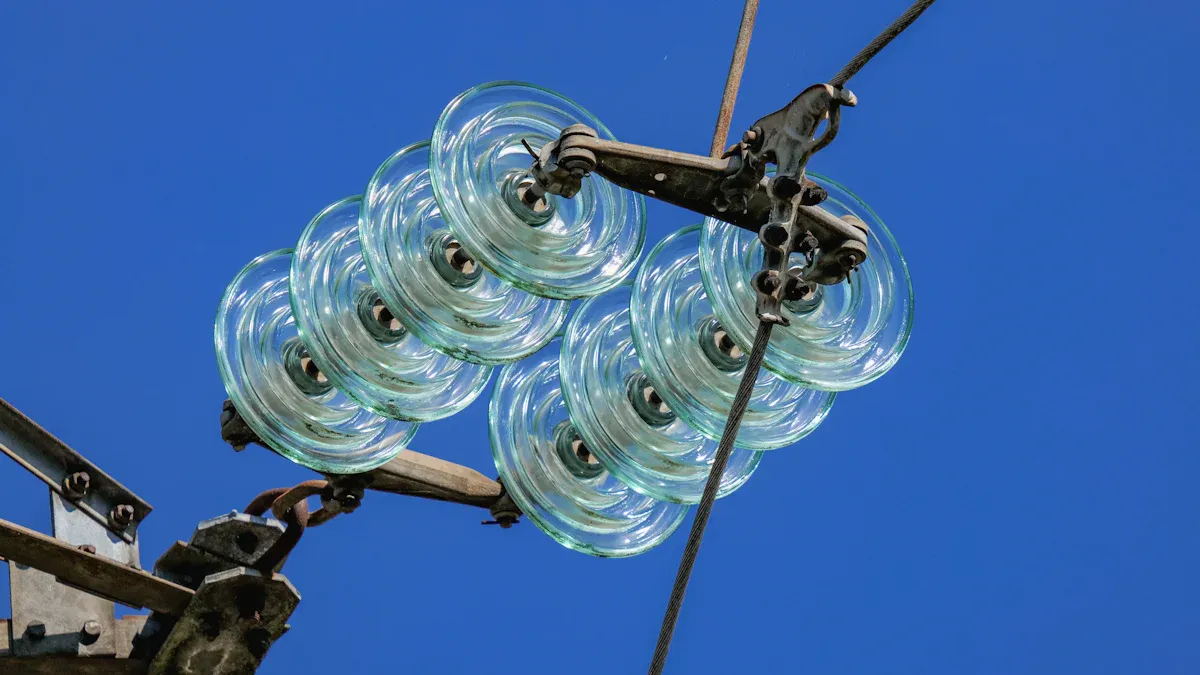
Suspension Insulators
Suspension insulators hang down from towers and hold up power lines. They are good for high-voltage lines because you can link many together. This helps them handle more voltage. These insulators need to be strong and dependable. Scientists test them in labs by putting them in fog and checking for flashovers. This helps pick the best insulator for dirty or wet places. The shape and what the insulator is made of changes how well it works in different weather.
| Performance Indicator | Value(s) | Description |
| Ultimate Tensile Fracture Loads | 551.3–583 kN | Maximum force before breaking |
| Maximum First Principal Stress | 94.5 MPa | Highest stress in porcelain shell under load |
| Bending Strength of Porcelain Shell | 100.5 MPa | Resistance to bending forces |
| Stress Reduction by Design Optimization | 31.6–47.6% | Improved strength by changing design |
Composite suspension insulators are even stronger and bend more easily. Their design lets them stand up to wind, ice, and earthquakes better than old types.
Strain Insulators
Strain insulators keep wires tight where lines turn or end. They must be tough against pulling and bad weather. Engineers test them for strength, bending, and how long they last. Most strain insulators use fiberglass rods and metal parts that do not rust.
- Specified Mechanical Load (SML) tells how much force they can take.
- Load ratings go from 16,000 to 36,000 pounds.
- Seven crimped fittings make strong connections.
- Hot-dipped galvanized hardware stops rust.
- Fiberglass rods last in sun and rain.
- Industry standards (IEC, ANSI, IEEE) check for safety and quality.
Other Common Types
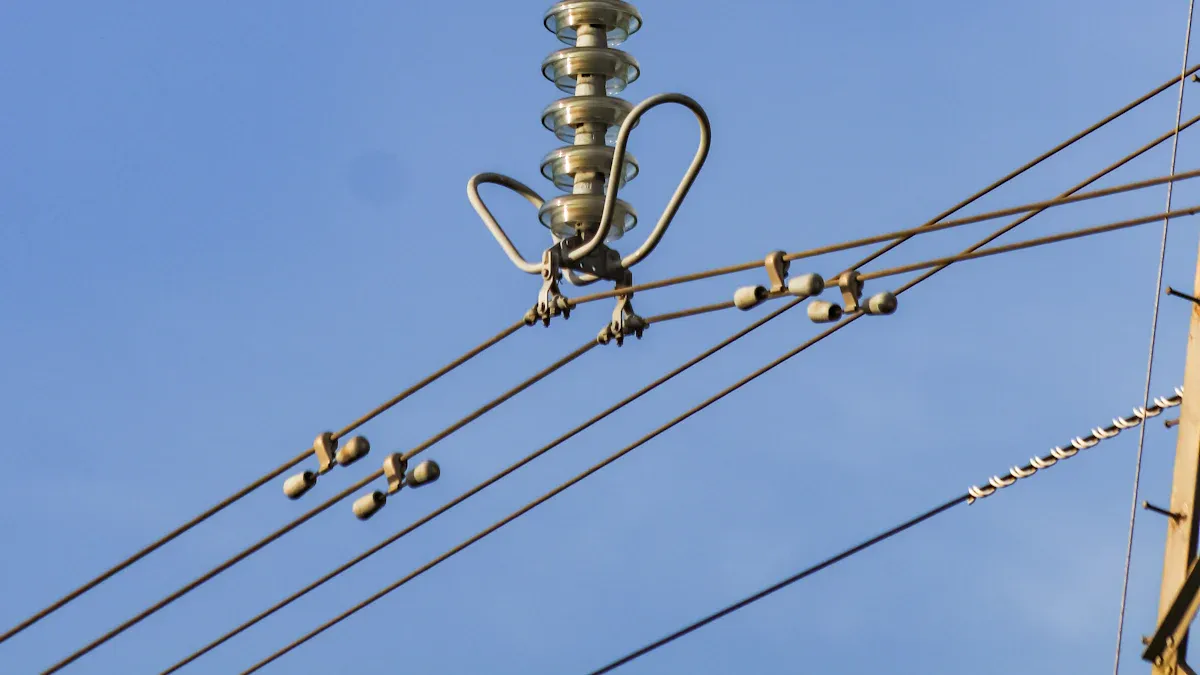
Other insulators are pin, post, and shackle types. Pin insulators sit on poles and hold lower voltage lines. Post insulators work in substations and small line designs. Shackle insulators help with short wires or sharp turns. The choice depends on voltage, weather, and cost.
Researchers use field tests and computers to compare these insulators. They see how dirt, rain, and heat change how they work. Studies show the right shape and material can stop flashovers and lower repairs. Utilities use data to track problems and plan fixes, so the power stays safe and reliable.
Insulator Materials
Porcelain
Porcelain insulators have been used for over 100 years. They are made from a special ceramic that blocks electricity and handles bad weather. Many power companies like porcelain because it lasts a long time. Some porcelain insulators work for more than 50 years, but some get weak after only 10 years. Their strength can go down as they get older, especially if the metal pin inside rusts. Tests show that about 74% of failures after 54 years happen in the pin. Engineers check porcelain insulators with both strength and electricity tests to find damage or aging. Porcelain insulators are heavy and can break easily, so they are harder to move and put up. Dirt and damage to the shiny coating can make them less safe in dirty places.
| Statistic Description | Value / Observation |
| Service time for studied insulators | 10 to over 54 years |
| Failure load reduction after 54 years vs 45 years | 14% lower |
| Percentage of failures in the pin after 54 years | 73.68% |
Glass
Glass insulators use strong glass to hold up wires and stop electricity from leaking out. They are good at handling bad weather and dirt. Companies like Statnett and Svenska Kraftnät check how often glass insulators break and test them with high-voltage shocks. Some groups of glass insulators fail up to 80% in tough tests, so checking quality is very important. Engineers use RIV tests to look for problems. High RIV means the insulator could break. Strength tests make sure the glass can hold wires, even if part of it cracks. Tests in labs and outside show that good glass insulators last many years and work well in different weather and voltage.
- Glass insulators need lots of tests to find weak ones.
- RIV and shock tests help spot problems before using them.
- Strong glass insulators keep wires safe and steady.
Composite Polymers
Composite polymer insulators are made from silicone rubber or special plastics. These insulators are much lighter than porcelain or glass—over 90% lighter. This makes them easier to carry and put up, even far away. Polymer insulators fight water and dirt because their surfaces stay dry. They dry fast and lose less power when it is wet. Studies show that polymer insulators can save over half the cost of materials and up to $2,500 per mile to install. Tests in the field show that silicone rubber insulators last at least six years with little damage. But sun, salt, and dirt can make them age, so engineers use new tools like hyperspectral imaging to find early wear. Composite polymers work well and last long, but regular checks help stop failures.
Tip: Polymer insulators are best for dirty or wet places because they clean themselves and keep power loss low.
Insulators and Environment
Weather Resistance
Insulators have to deal with many kinds of weather. They need to work in heat, cold, wind, rain, and ice. Engineers test insulators in labs and outside. They want to see how much voltage the insulators can take with ice or dirt on them. The creepage factor is important for this. It is the surface distance divided by the arcing distance. This helps engineers pick the right size and strength for an insulator. In cold places with ice, the creepage factor must be higher, sometimes up to 3.6, to keep things safe.
- Tests show icing is more risky than just pollution. Icing makes flashover more likely.
- Engineers watch leakage current harmonics to know if an insulator might fail.
- Standards like IEC 60273 help with designing and testing insulators for different weather.
A study found that water drops on insulators can make the electric field over 30% stronger. More water or more pollution makes damage more likely. High places with thin air also make it easier for electricity to jump. This can wear out insulators faster.
Pollution and Maintenance
Dust, salt, or chemicals can stick to insulators and cause trouble. If too much dirt builds up, electricity can leak or flashover can happen. Power companies clean insulators near the sea or in forests to keep them working well. For example, the L-2109 line near the sea has been cleaned by hand since 2010. In more than ten years, it only failed once, and that was not because of the insulator.
The L-1124 line in a forest had lots of failures at first. After using better silicone insulators and cleaning them twice a year, failures dropped a lot. Some of these insulators have lasted up to 18 years. Now, most problems come from storms, not the insulators.
Machine learning models help companies know when to clean insulators. These models use data like leakage current, temperature, and humidity. They can tell if an insulator is dirty with almost 99% accuracy.
Regular checks and cleaning help insulators stay safe and work well, even in hard places.
Benefits of Insulators
System Reliability
Insulators help power systems run with fewer breaks. When engineers use insulators that check themselves, the system works almost all the time. Early problem finding means fewer outages, up to 78% less. On some 400kV lines, outages from insulators dropped by 82%. Now, workers wait 5 years between checkups instead of 2. Equipment lasts 6 to 10 years longer. These changes mean less fixing and less time without power.
| Metric Description | Improvement/Value |
| System uptime with self-diagnostic capabilities | 99.97% |
| Reduction in insulator-related outages (400kV lines) | 82% |
| Outage reduction due to early failure detection | Up to 78% |
| Extension of maintenance intervals | From 2 years to 5 years |
| Equipment lifespan extension | 6 to 10 years |
Tests show that making live metal parts farther apart lowers the electric field. This helps the system stay steady, even when the weather is bad.
Safety Enhancement
Insulators keep people and equipment safe from shocks. They stop current from jumping between wires or to the ground. Studies show that better insulator materials, like silicone rubber, lower flashover risk even with lots of dirt. Salt and dust together can cut flashover risk by half. Silicone rubber insulators stay safe when dirty because water rolls off them. Cleaning often and using new insulators lowers accident chances. New tools, like AI and IoT, help find problems early and keep things safe.
Tip: Insulators with water-repelling surfaces work best where there is lots of dirt or water.
Power Efficiency
Insulators help power lines send electricity with less waste. When engineers use insulators that fight dirt and water, less current leaks out. Pollution tests show salt and dust can make flashover easier, but good insulators stop this. Cost studies show that how many insulators are used changes the price of a power line the most. Better insulator designs save money and help power flow better.
- Insulators cut down wasted energy.
- They help keep voltage steady.
- Good insulators mean fewer repairs and lower costs.
Insulators keep power lines safe by stopping flashovers. They help electricity move safely along the wires. Research shows that using more insulators raises flashover voltage. This makes power systems work better, even when the weather is bad. As people use more electricity, engineers add insulators to keep energy safe and steady. New ideas, like smart insulation and nanomaterials, help insulators last longer and work better. The market for suspended insulators is growing quickly, showing they are important in today’s power systems.
FAQ
What happens if a transmission line does not use insulators?
If there are no insulators, electricity can leak out. This might start fires or cause shocks. Power could also go out. Insulators keep electricity inside the wires. They help protect people and equipment from harm.
How do engineers choose the right insulator material?
Engineers think about weather, pollution, and voltage. They choose porcelain, glass, or polymer. Each type fights dirt, water, and heat in its own way.
Tip: Polymer insulators are best where there is lots of pollution or rain.
Can insulators break or wear out over time?
Yes, insulators can crack, get dirty, or get weak. Checking them often helps find problems early. Most insulators last a long time if cleaned and cared for.
Why do some insulators have a long, bumpy shape?
The bumpy shape makes electricity travel farther on the surface. This helps stop leaks and flashovers in wet or dirty weather.
- More bumps give better protection.
- Engineers call this the “creepage distance.


