


To pick the right switchgear for your project in 2025, you need to match your equipment to your voltage, current, load, and safety needs. You should also think about future needs like digital monitoring and saving energy. The global switchgear market will be worth USD 168.8 billion in 2025. This is because of more cities, more renewable energy, and stronger safety rules. You must look at both technical and practical things to keep your project safe and working well.
| Metric/Aspect | Data/Projection | Notes/Drivers |
|---|---|---|
| Market Size 2025 | USD 168.8 billion | Growth from more cities, renewables, safety |
| Asia Pacific Growth | Fastest-growing region | Caused by spending on new buildings and roads |
| Technological Drivers | IoT, AI, smart systems | Helps with live monitoring and smart actions |
Key Takeaways
- Pick switchgear that matches your project’s voltage and current. Make sure it meets safety needs. This helps keep your system safe and working well. – Talk with your team early. Check power loads, site conditions, and space. This helps you avoid mistakes and delays. – Follow safety rules. Choose switchgear approved by trusted groups. This keeps people and equipment safe. – Think about using digital and smart switchgear. These can watch your system live. They help stop problems and save energy. – Pick makers with a good name, support, and certifications. This helps you get good quality and long-term success.
Switchgear Basics
What Is Switchgear
Switchgear helps control and protect electrical equipment. It can also separate equipment in a power system. Groups like IEEE and ANSI say switchgear is a set of devices. These include disconnect switches, fuses, and circuit breakers. They help manage how electricity moves. The National Electrical Code (NEC) says switchgear is a metal box. This box holds devices for switching and stopping power. It also has buses and connections inside. You will find control and extra devices there too. You can reach them through doors or covers.
- Switchgear has:
- Electrical disconnect switches
- Fuses
- Circuit breakers
- Control and extra devices
These parts let you turn off equipment for repairs. They also help fix problems in the system. Rules like IEEE Std C37.100-1992 and IEC set how switchgear is made and rated everywhere.
Key Components
Switchgear has many main parts. Each part does something important. The table below lists the main parts and what they do:
| Component Category | Components Included | Functions |
|---|---|---|
| Power-conducting parts | Switches, circuit breakers, fuses, lightning arrestors, insulators, bus bars, bushings | Stop and control electric current; turn circuits on or off; protect from problems and too much power |
| Control-system parts | Relays, current transformers, potential transformers, control panels | Find problems, check system status, protect power parts, allow control and checking |
| Bus Bars | Conductors connecting circuit breakers and overhead lines (external or internal) | Move electric current between parts |
| Bushings | Insulators letting high-voltage wires go through grounded metal | Give insulation and protect high-voltage wires |
You need these parts to keep your system safe and easy to fix.
Why It Matters
Switchgear is very important in your electrical setup. The right devices keep your system safe from problems and too much power. Circuit breakers, fuses, and relays quickly shut off bad sections. This keeps power going to good parts and stops damage from spreading. You also lower the chance of fires and broken equipment. Checking and testing your switchgear often helps it last longer and work well. If you follow safety rules, you keep your equipment and team safe.
Tip: Always pick switchgear that follows industry rules. This helps keep your project safe and reliable.
Switchgear Types
Low Voltage
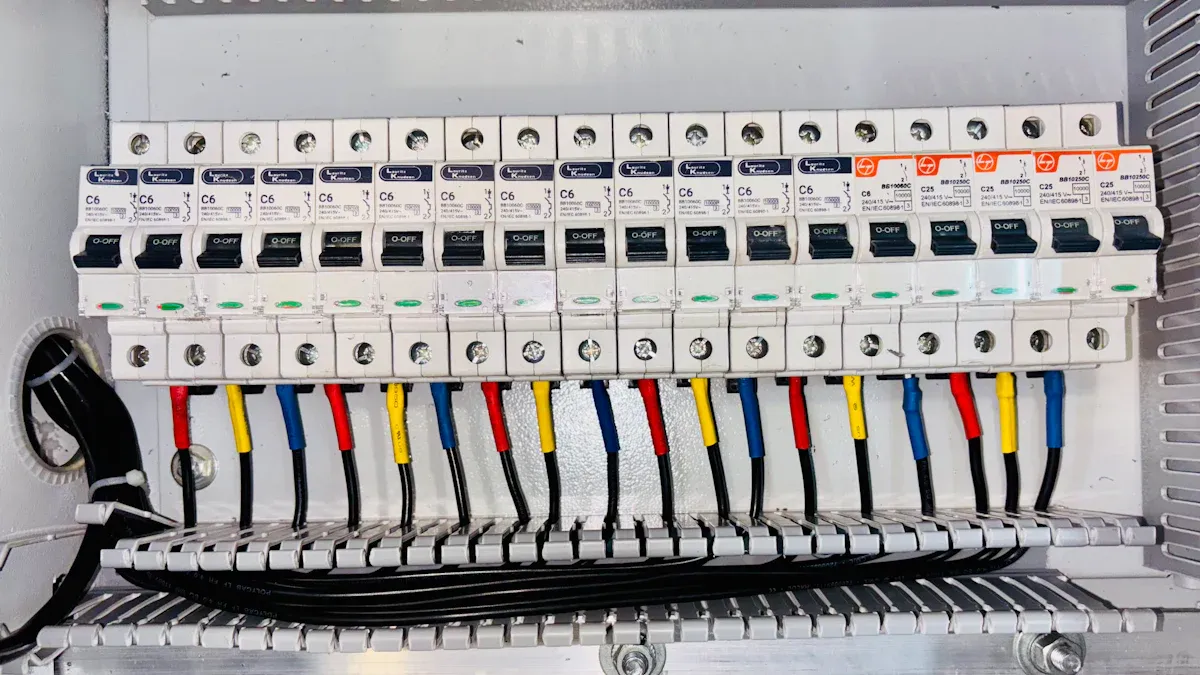
Low voltage switchgear is used in schools, hospitals, offices, and homes. It works with voltages up to 1,000 volts and currents up to 6,000 amps. Most of the time, it is put inside metal boxes indoors. This type keeps equipment safe from short circuits and too much power. You can find it in power stations and transformer stations. It is also used in many industries like automotive, chemicals, pharmaceuticals, and mining. Low voltage switchgear keeps buildings safe and helps power move where it is needed.
Tip: Pick low voltage switchgear if you need good protection and control for homes or businesses.
| Switchgear Type | Voltage Range | Typical Components | Common Applications |
|---|---|---|---|
| Low Voltage (LV) | Up to 1 kV | Circuit breakers, isolators | Schools, hospitals, offices, homes, data centers |
Medium Voltage
Medium voltage switchgear works with voltages from 1,000 to 36,000 volts. It is used in big factories, utility stations, and large buildings. This type gives strong protection and control for bigger systems. It uses insulation like mineral oil or SF6 gas to keep things safe. Medium voltage switchgear helps control power in factories, renewable energy sites, and heavy industries like mining and railways.
| Switchgear Type | Voltage Range | Key Functions | Common Applications |
|---|---|---|---|
| Medium Voltage (MV) | 1 kV to 36 kV | Control, monitoring, arc flash protection | Industrial plants, utilities, renewable energy, mining |
High Voltage
High voltage switchgear is for voltages above 36,000 volts. You see it in power plants, transmission lines, and big industrial centers. This type uses special insulation and arc protection to keep things safe. High voltage switchgear helps send power over long distances and handles big power loads. It uses air or gas insulation and special circuit breakers to protect equipment.
| Switchgear Type | Voltage Range | Key Functions | Common Applications |
|---|---|---|---|
| High Voltage (HV) | Above 36 kV | Power transmission, system stability | Power plants, transmission lines, large industries |
Indoor vs Outdoor
You need to choose between indoor and outdoor switchgear. Indoor switchgear keeps people safe and blocks dust, water, and weather. It is good for small spaces and looks nice in offices or stores. You do not have to fix it as much because it is not outside.
- Advantages of Indoor Switchgear:
- Keeps people safe from live parts
- Stops dust and water from getting in
- Works well during storms or bad weather
- Saves space in small buildings
- Looks nice in public places
Outdoor switchgear is for when you need equipment outside, like at substations or far-away places. It has to deal with wind, rain, and snow, so you might need to fix it more often. Your choice depends on what your project needs, where it is, and how much money you have.
Selection Steps
Assess Project Needs
Begin by talking with everyone on your team. This means the general contractor, facility manager, and others. Each person may want something different for the electrical system. Look at how much power you need and what voltage is used. Think about what kinds of loads you have, like motors or lights. Check if your project uses 50Hz or 60Hz. Look at the area where the switchgear will go. Notice the temperature, humidity, dust, or anything that could cause rust. Decide if the switchgear will be inside or outside. Measure the space and see if there are any problems getting to it. Doing this now helps you avoid trouble later and makes sure the equipment fits.
Tip: Working with everyone early helps you avoid mistakes and keeps your project on time.
Calculate Load and Ratings
You need to figure out how much power your equipment will use. Make a list of everything that needs electricity. Use diversity factors so you do not guess too high. Change the total load into kilovolt-amperes (kVA). Use this formula:
Inom = P / (V * PF)
Here, Inom is the current rating, P is power in watts, V is voltage, and PF is power factor.
This helps you pick switchgear that can handle the most current. Always choose a rating higher than what you need. This gives you room to grow and keeps things safe. Good load calculations stop overloads and help your system work well.
| Step | Action |
|---|---|
| List Loads | Write down all equipment and devices |
| Apply Diversity | Adjust for things not used at the same time |
| Convert to kVA | Find the total load in kilovolt-amperes |
| Calculate Current | Use the formula to get the current needed |
Duty Cycle and Conditions
How long your switchgear lasts depends on how you use it. If your system runs all day, like in a data center, you need strong equipment. Hot weather, high humidity, and dust or chemicals can wear it out faster. Rules like IEC 62271-1 set limits for temperature and other things. For example, the average temperature should not be over 35°C in 24 hours. The highest should not go above 40°C. This stops your equipment from getting old too soon. If your site has lots of moisture or salt, pick materials that do not rust. Good design and checking your equipment often help it last longer and stay safe.
Note: Always make sure your switchgear matches the real conditions at your site for best results.
Safety and Standards
You must follow safety rules when picking switchgear. In the US, look for IEEE, ANSI, NEMA, NEC, and UL labels. These rules cover how things are made, tested, and used safely. In Europe, IEC rules and F-gas laws are used. In Asia, Chinese GB rules are common. These rules make sure your equipment is safe and legal. Groups like OSHA check that you use the right products. Many makers build their products to meet more than one rule. This lets you use them in different places. Always check that your switchgear meets the newest rules for your area.
- Key Standards:
- IEEE C37 series
- IEC 62271 and IEC 61439
- ANSI C37 series
- NEMA SG-5
- NEC (NFPA 70)
- NFPA 70E and NFPA 79
- UL 1558
Stakeholder Input
Get everyone involved early in the project. This means contractors, facility managers, engineers, and inspectors. Each group knows something important about the project. Early talks help you find problems, like space or code issues. It also helps you plan for other systems, like HVAC or security. Good communication keeps your project moving and stops delays. Write down every choice and keep records up to date. Use clear names for equipment and change diagrams as needed. This makes it easier for everyone to understand and take care of the system.
Callout: Keep your records simple and easy to read. Update them with every change so no one gets confused later.
Custom Design
Sometimes, regular switchgear does not work for your project. Custom switchgear can help in many ways. You can make things safer, more reliable, and save energy. Custom designs let you meet special needs and follow extra rules. They also help you stop downtime and make equipment last longer. You work with the maker, pick the right parts, and test everything before using it. Custom switchgear may cost more and take longer to get, but you save money later by avoiding problems. Clear instructions and help from the maker make repairs and care easier.
- Benefits of Custom Switchgear:
- Safer and more reliable
- Saves energy
- Meets all rules
- Lasts longer
- Can be made for special needs
- Challenges:
- Costs more at first
- Takes longer to get (15–25 days)
- Harder to take care of
Tip: Think about the long-term benefits and the first cost. Custom switchgear often saves you money by working better and breaking less.
Future-Proofing
Digital Switchgear
You can get ready for the future by picking digital switchgear. This kind of switchgear uses sensors, IoT, and AI to give you live data and smart controls. You can find problems faster and even guess when something might go wrong. Digital twins let you test your system safely on a computer. These tools help you control loads, stop long outages, and keep things working well. You also use greener materials, which is better for the planet. Cybersecurity is very important, so your data and system stay safe.
- Live monitoring and easy-to-read reports
- AI helps you fix things before they break
- Computer models help you plan better
- Greener materials are better for the earth
- Strong cybersecurity keeps your data safe
Tip: Checking your switchgear often and using digital tools can make it last up to 25% longer.
Automation and IoT
Automation and IoT have changed how you watch and fix your electrical systems. Smart sensors check temperature, humidity, and dust inside and outside your equipment. You can spot problems early and fix them before they get worse. AI and machine learning help you see odd patterns and plan repairs at the best time. You can check your system from anywhere, which saves time and money. These tools also help smart grids work better and make your energy use more flexible.
For example, microclimate sensors in switchgear cells can find bad conditions early. The system sends alerts to your team, so you can fix things before they cause big problems.
Note: Automation and IoT help you spend less on repairs and make things safer by using data to make choices.
Energy Efficiency
Modern switchgear helps you save energy. Smart technology lets you watch and control your system all the time. You can use less power and waste less, which saves money. Many systems now work with solar, wind, and other green energy, so it is easier to use renewables. Top brands make their products to meet strict rules like UL, IEC, and ISO 9001. These rules make sure the products are safe, high quality, and good for the environment.
| Manufacturer | Certifications/Standards | Energy Efficiency Features |
|---|---|---|
| ABB | IEC, ISO 9001 | Digital tools, ready for smart grids |
| Siemens | IEC, global standards | Green design, smart monitoring |
| Eaton | Modern grid standards | Automation, easy to add on, helps the planet |
Callout: Picking switchgear that is certified and saves energy helps you stay safe and protect the environment.
Manufacturer Choice
Reputation and Support
When you pick a manufacturer, you want someone you can trust. A good reputation means the company makes quality products and supports them. There are many things to check when you look at a manufacturer’s reputation and support:
- Check if they use strong materials like stainless steel or coatings that stop rust.
- Make sure their products follow safety rules like IEC, UL, or ANSI.
- Ask if they can make special products for your needs.
- See how fast and helpful their customer service and technical support are.
- Make sure they deliver on time and keep enough products in stock.
- Look for new features like digital monitoring or IoT.
- Check the warranty, how big their service team is, and what other customers say.
- Find out if they plan to add new technology in the future.
Tip: Read what customers say and ask about the warranty. Good support can help you save time and money over many years.
Certifications
Certifications show a manufacturer follows strict safety and quality rules. You should look for these marks when you compare products:
| Certification/Standard | Description | Importance for Switchgear Products |
|---|---|---|
| ISO 9001 | Quality management system certification | Makes sure the company has good quality control |
| BS EN IEC 61439 Part 1 & 2 | Standards for power switchgear and controlgear assemblies | Sets rules for safe design and testing |
| ASTA Certification | Independent testing for safety and performance | Shows the product meets important safety rules |
| CCC (China) | China Compulsory Certification | Meets China’s safety and quality rules |
| UL/CSA (North America) | US and Canadian safety certifications | Makes sure it follows local safety rules |
| UKCA (United Kingdom) | UK Conformity Assessed mark | Meets UK’s special safety rules |
These certifications help you know the switchgear is safe and will work well in your project.
Expert Advice
You should always talk to experts or engineers before you decide. Their advice helps you avoid mistakes and keeps your system safe. Experts can:
- Do studies like insulation checks and short-circuit tests.
- Pick the right size for instrument transformers so nothing breaks.
- Update single line diagrams and make digital twins for better planning.
- Use special software to model your system and stop errors.
- Give you custom solutions for your needs and safety.
Note: Expert advice helps you balance cost, safety, and how well things work. You get a solution that fits your project and follows all the rules.
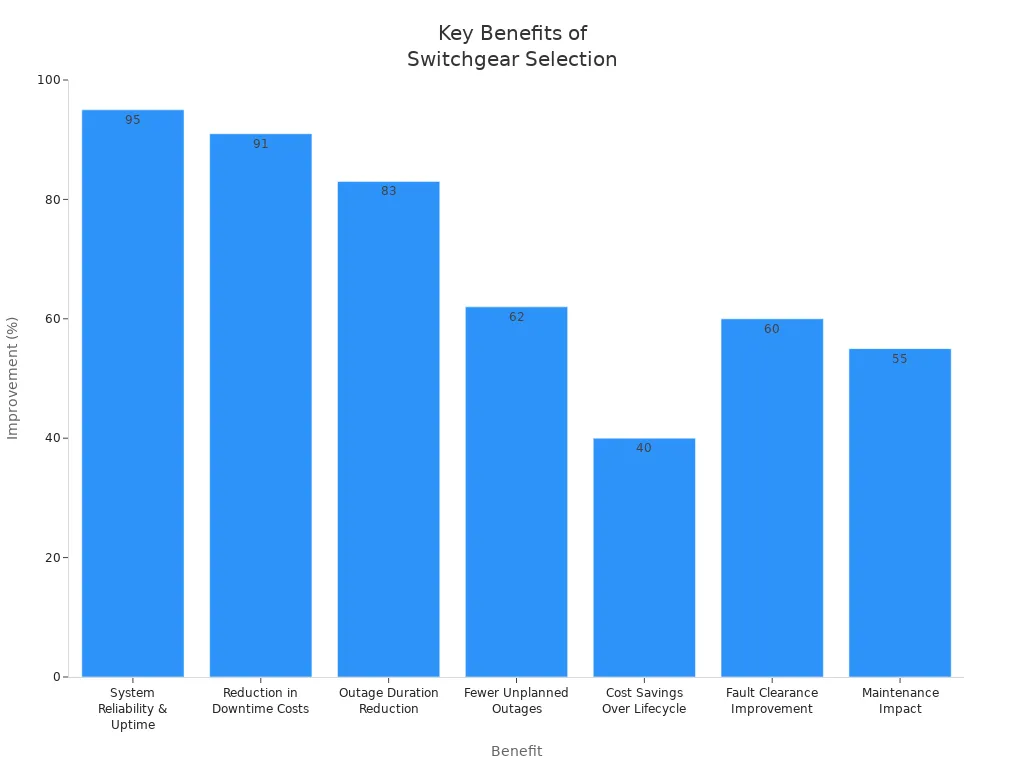
Picking the right equipment means you must know your system type. You also need to figure out how much power you need. Safety is very important for your team. You should also think about what you might need in the future. If you follow steps in order, your project will work better. This can help you spend less money and keep everyone safe. People often make mistakes if they skip design checks or forget about arc flash dangers. Not planning space well is also a problem.
- Not checking the design
- Forgetting about arc flash safety
- Not planning enough space
- Using arc-resistant labels the wrong way
- Letting people work who are not trained
- Not keeping good records
Make sure you get the right project information. Talk to trained experts or the company that makes the equipment. This will help your project work well for a long time.
FAQ
What is the main purpose of switchgear in a project?
Switchgear keeps your electrical system safe from problems. It helps you turn equipment on and off safely. You can fix or check things without danger. Using the right switchgear protects people and equipment.
Tip: Pick switchgear that matches your system’s voltage and current.
How do you know which switchgear type fits your project?
You need to know your project’s voltage, current, and load. You also check the area and safety rules. Low voltage is good for homes and offices. Medium and high voltage are used in factories and power plants.
| Type | Common Use |
|---|---|
| Low Voltage | Homes, offices |
| Medium | Factories |
| High | Power stations |
Why should you consider digital switchgear?
Digital switchgear gives you live data and smart controls. You can find problems early and fix them before they get worse. This saves money and makes your system safer.
What certifications should you look for in switchgear?
You should look for marks like IEC, UL, and ISO 9001. These show the product is safe and high quality. Certified switchgear helps your project follow the rules and work well.
Can you customize switchgear for special needs?
Yes, you can ask companies to make custom switchgear. This helps if you have special spaces or safety needs. Custom switchgear may cost more, but it can last longer and fit your project better.


