


High voltage insulators keep electricity inside power lines and away from towers or the ground. You depend on these insulators to stop current from leaking out, even when rain, dirt, or pollution are on them. Their strong materials and smart designs make sure electricity does not jump across gaps or cause dangerous arcs. Cleaning them often and using water-repellent surfaces help lower the chance of power outages and equipment failures.
Key Takeaways
- High voltage insulators keep electricity inside power lines. They protect people and equipment by blocking electric current. They also stop dangerous arcs from happening.
- Strong materials like porcelain, glass, and polymers are used. Smart designs like ridges and long creepage distances help insulators work well. They still work in bad weather and when they get dirty.
- Insulators stop electricity from leaking out. They also hold up power lines safely during storms, wind, and ice.
- Manufacturers use strict steps and tests to make sure insulators are strong. They check that insulators are reliable and meet international safety rules.
- Regular inspection and cleaning of insulators help stop failures. This keeps power steady and helps insulators last longer.
High Voltage Insulators Overview
Definition
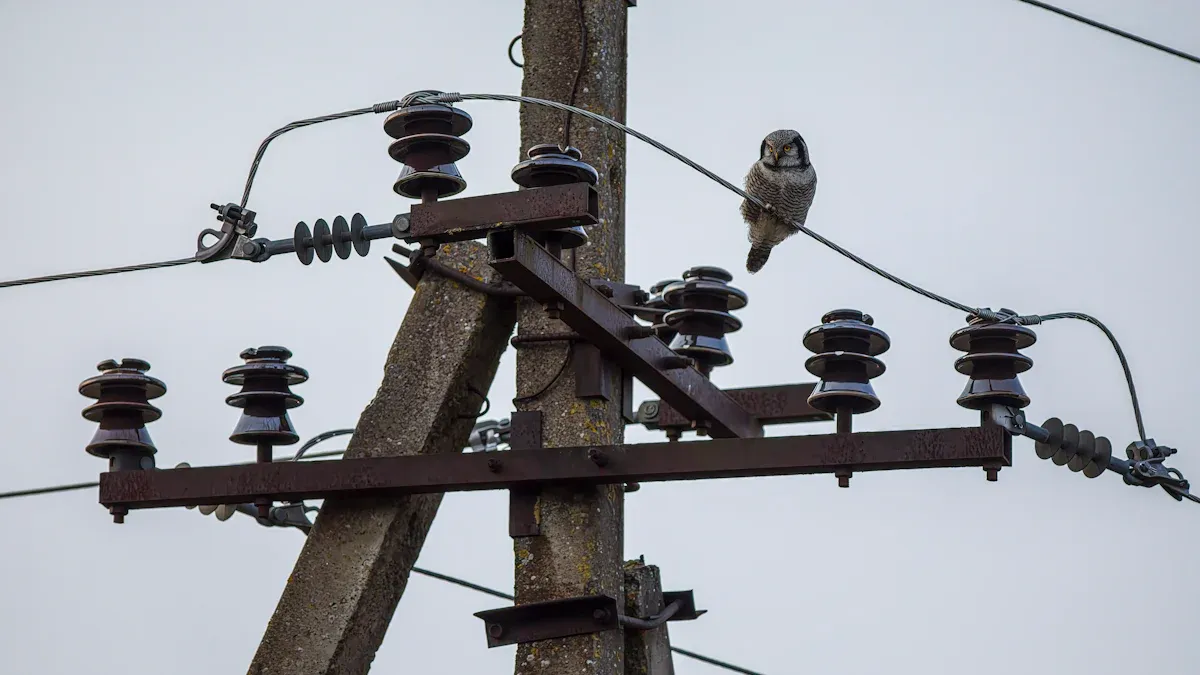
You can spot high voltage insulators on power lines and towers. These devices stop electricity from leaving the wires. They keep it from touching metal parts or the ground. High voltage insulators use special materials that block electric current. Think of them as tough shields for electricity. They make sure electricity stays where it should. Without these insulators, power lines would not be safe. Electricity could get out and hurt people, animals, or equipment.
Main Functions
High voltage insulators do many important jobs in power systems. You need them for safety and steady power. Here are their main functions:
- They handle strong electric fields and insulate high-voltage lines.
- They stop electric current from harming people or the environment.
- They hold up power lines and give them support, even in storms.
- They resist high voltages and currents so you get steady power.
- They work in hot weather and keep working in tough conditions.
- They help save energy and last for many years.
Tip: When you look up at power lines, remember high voltage insulators help keep you safe and hold the lines up.
How High Voltage Insulators Work
Blocking Current
You need high voltage insulators to keep electricity inside power lines. These insulators use special materials that stop electric current from passing through. Here is how they do this:
- The materials do not let heat or energy move easily. This makes it hard for electrons to flow.
- They have high dielectric strength. This means they can handle strong electric fields without breaking.
- High voltage insulators must be tough and last a long time. They work even when there is wind, rain, or dirt.
- Good thermal stability helps them deal with heat from the wires. They do not melt or crack.
- Engineers use materials like mica film, irradiated polyethylene, and polyester. These materials block electricity very well.
The design of these insulators is all about stopping current. They work even when the voltage is very high. This keeps you and your community safe.
Note: Picking the right material is important. It helps block current and makes the insulator last for years.
Preventing Arcing
Arcing happens when electricity jumps across an air gap or over an insulator. High voltage insulators stop this by using smart designs and careful tests. One key thing is the creepage distance. This is the shortest path along the surface between two metal parts. A longer creepage distance helps stop current from leaking. This is important when the insulator is dirty or wet.
- Creepage distance keeps electricity from moving along the surface. This stops flashover.
- Insulators have sheds or ridges. These make the creepage distance longer and help wash away dirt and water.
- In places with lots of pollution or salt, you need even longer creepage distances. This keeps the insulator working well.
- International standards say how long the creepage distance should be. It depends on the environment and voltage.
You also need to know about flashover voltage and puncture voltage. These show how much voltage an insulator can take before it fails.
| Aspect | Flashover Voltage | Puncture Voltage |
| Definition | Voltage where electricity jumps over the insulator surface | Voltage where the inside of the insulator breaks down |
| Test Setup | Insulator is set up like in real use; voltage goes up slowly; tested in dry or wet conditions | Insulator is put in oil; voltage goes up until it breaks inside |
| Phenomenon | Surface discharge happens because air or dirt breaks down | The inside of the insulator fails and lets current through |
| Purpose | To check if the insulator can handle surface discharges | To check the strength inside the insulator material |
| Related Conditions | Outside things like dirt, water, or air breaking down | Inside material strength and insulation quality |
| Test Duration | Voltage stays for a set time with no flashover | Voltage goes up until the insulator breaks inside |
This table shows that flashover voltage is about problems on the surface. Puncture voltage is about the strength inside the insulator.
You can also look at the Basic Insulation Level (BIL). This tells you how well an insulator stops arcing at different voltages. The chart below compares BIL ratings for distribution and power class insulators:

Tip: Longer creepage distance and higher BIL ratings give better protection against arcing. This is very helpful in tough environments.
Mechanical Support
High voltage insulators do more than just block electricity. They also hold up heavy power lines and keep them in place. These insulators must handle strong forces from the wires, wind, and ice.
- Suspension insulators use disc-shaped pieces linked together. This string holds the wire and lets it move a little.
- Each disc is made for a certain voltage. You can add more discs for higher voltages.
- The string design helps lower stress from wind or ice. This keeps the wires from snapping.
- Strain insulators are used at sharp corners or where the line ends. They handle strong pulling forces.
- These designs keep the wires in the right place, even during storms or heavy loads.
High voltage insulators must be very strong. This makes sure they work well, no matter what the weather is like.
Remember: The strength and design of these insulators protect the power system. They help keep electricity flowing safely to your home.
Types and Materials

Porcelain
Porcelain insulators are common on power lines. Porcelain is a ceramic made from clay, quartz, alumina, and feldspar. This material gives high mechanical strength and great electrical insulation. Porcelain insulators can handle bad weather, dirt, and heat. They last a long time and do not need much care.
- High dielectric strength helps stop electricity from escaping.
- They are strong enough to hold heavy wires and survive storms.
- The smooth glaze helps water slide off and keeps them clean.
- Porcelain is about four times harder than stainless steel.
Special crystals inside porcelain make it strong. The chart below shows how different mixes change bending strength:

Tip: Porcelain insulators follow strict international rules for safety and performance.
Glass
Glass insulators have even higher dielectric strength than porcelain. Their smooth surface keeps away dust and dirt. You can see problems easily because glass is clear. If a glass insulator breaks, it shatters, so you notice right away.
| Property / Feature | Porcelain Insulators | Glass Insulators |
| Dielectric Strength | ~60 kV/cm | ~140 kV/cm |
| Mechanical Strength | High compressive | High tensile |
| Surface Properties | Rougher | Smoother |
| Transparency | Opaque | Transparent |
| Lifespan | Longer | Shorter |
| Weight | Heavier | Lighter |
| Cost | Less costly | More costly |
Glass insulators work well in dirty places and are easy to check. But they can break more often than porcelain.
Polymer
Polymer insulators have a plastic rod with a silicone rubber or EPDM cover. These insulators are light and easy to put up. Polymer insulators resist water and pollution very well. Their flexible design lets you use them in many ways.
- Lighter weight makes them easy to install.
- High hydrophobicity keeps water from sticking.
- Good for places with lots of pollution.
- Flexible shapes fit many uses.
But polymers can get old from sun and weather. They may not last as long as porcelain or glass. You need to check them more often for damage.
Shapes and Applications
The shape of an insulator is important. You pick the shape based on the place and the job. Some shapes make the creepage distance longer, which helps in dirty or salty places. Other shapes are made to handle strong winds.
- Standard shapes are good for clean, dry places.
- Anti-pollution shapes help in dusty or coastal areas.
- Aerodynamic shapes lower wind stress.
Note: The right shape and material keep power lines safe and working, even in tough places.
Manufacturing and Quality
Production Steps
Have you ever wondered how high voltage insulators get so strong? Factories follow many careful steps to make sure each one is reliable. Here is how they make these important devices:
- Material selection and procurement: First, workers pick the best raw materials. These must be high quality and good for the environment.
- Raw material preparation: Next, workers measure and mix the materials. They use big silos and add water to make a smooth mixture.
- Shaping: Machines press the mixture into shape. They use high pressure to form the insulator body.
- Drying: The shaped parts go into special rooms. These rooms remove water and stop cracks from forming.
- Final geometry shaping: Skilled workers use lathes to finish the shape. They make sure the shed geometry is just right.
- Glazing: Workers dip or spray on a glaze. This smooth layer helps keep the insulator clean and dry.
- Firing: The insulators are baked in hot kilns. The heat makes them strong and tough.
- Assembly: Metal parts are added to the insulator. Sometimes, special glue is used for very high voltages.
- Quality control: Workers check for problems at every step. They look for defects during drying, shaping, and firing.
- Packing and shipment: Finished insulators are packed with care. This keeps them safe while they travel to power stations.
Tip: Every step helps make sure insulators are safe and last a long time.
Testing and Standards
You need to know that high voltage insulators will work for many years. Factories test each insulator using strict rules from groups like IEEE and IEC. These tests check for electrical strength, breakdown resistance, and toughness.
Here are some important ASTM standards used for testing:
| ASTM Standard Number | Test Method Description |
| D3756-18 | Checks resistance to electrical breakdown by treeing |
| D3426-19 | Tests dielectric breakdown voltage with impulse waves |
| D149-20 | Tests dielectric breakdown voltage at power frequencies |
| D3755-20 | Tests dielectric breakdown under direct-voltage stress |
| D2303-20e1 | Checks tracking and erosion with liquid contaminants |
| D495-22 | Tests dry arc resistance of insulation |
| D3638-21e1 | Checks comparative tracking index |
| D2275-22 | Tests voltage endurance under partial discharges |
| D150-22 | Checks AC loss and permittivity of insulation |
| D374/D374M-23 | Measures thickness of solid insulation |
Factories also test for strength and how well insulators handle weather. These tests make sure insulators work in real life. When you see them on power lines, you can trust they passed hard tests and meet world safety rules.
Note: Good testing and strong rules help keep your electricity safe every day.
Performance and Challenges
Electrical Properties
You count on high voltage insulators to keep electricity safe. In labs, experts test many electrical properties to make sure they work right. They check for surface tracking in dry and wet weather. They also test dielectric strength and breakdown voltage. Corona discharge resistance is another thing they look at. Surface and volume resistivity are measured too. Dielectric strength is very important. It shows how much electric field the insulator can take before it fails. Ceramics, silicone rubber, and EPDM have high dielectric strength. These tests help stop insulation failure and keep your power safe.
Tip: High dielectric strength gives better protection from electrical breakdowns.
Mechanical Strength
Insulators must be strong to handle hard conditions. Factories test them by pulling, bending, and twisting. They see how much force the insulator can take. They measure tensile load and deflection. Two main numbers are Specified Mechanical Load (SML) and Rated Tensile Load (RTL). These show how much weight or force the insulator can hold before breaking. Tests look for buckling and ultimate strength. Most failures happen at bolts or the post. Engineers keep making designs better to meet new standards. Strong insulators keep power lines up in storms, wind, and earthquakes.
Environmental Factors
Weather and the environment change how well insulators work. Many things can cause problems for them. Pollution and salt in the air raise the risk of flashover. Rain can wash dirt away but also help moss grow. UV rays from the sun can break down some materials. Extreme heat or cold changes how strong the insulator is. Wind, lightning, and birds can hurt insulators. Biological growth and animals can damage the surface. These things are different in every place, so insulators must fit local needs.
Maintenance
Insulators last longer if you take care of them. Good maintenance is important for safety. You should inspect them often to find cracks or chips early. Cleaning removes dirt and pollution with water, dry, or rough methods. Testing for surface resistance and partial discharge finds problems before they get worse. You also need to check for corrosion and keep insulators dry. Utilities use special tools to measure tan delta and partial discharge. These checks help find hidden problems and stop sudden failures.
Note: Regular care and testing keep your power safe and reliable, even in tough places.
You need high voltage insulators to keep power safe and steady. Engineers pick strong materials and use smart designs. This makes the insulators work well for a long time. The table below shows what helps:
| Material Factor | Impact on Reliability |
| Tracking resistance | Stops surface breakdown and leakage |
| Resin content | Reduces voids and prevents early failure |
| Thermal expansion match | Prevents cracks from temperature changes |
| High glass transition temp | Keeps shape under heat |
Checking and cleaning insulators often helps them last longer. New materials and better designs will make power grids safer soon.
FAQ
What happens if a high voltage insulator fails?
If an insulator fails, electricity can escape from the power line. You might see sparks or hear a loud noise. This can cause power outages or even fires. Utility workers must replace the damaged insulator quickly to keep you safe.
How do you know when to replace an insulator?
You should look for cracks, chips, or burn marks on the insulator. If you see dirt that will not wash off or signs of arcing, it is time to replace it. Regular inspections help you find problems early.
Why do insulators have ridges or sheds?
Ridges or sheds increase the creepage distance. This design helps keep water and dirt away from the main surface. You get better protection against current leaks and flashover, especially in wet or dirty places.
Can you clean high voltage insulators yourself?
You should never try to clean high voltage insulators on your own. Only trained workers with special tools can do this job safely. High voltage lines are very dangerous. Always stay away and call your utility company if you see a problem.


